
2025
In a modern diesel powertrain, electrical reliability is not a luxury. It is what regulatory compliance, telematics uptime and driver safety all rest on. When lights flicker or an Electronic Control Module (ECM) resets mid-route, the technician has to determine quickly whether the alternator or the battery is at fault. Getting it wrong doubles the labor, extends the downtime and costs customer confidence. What follows is a disciplined, meter-first approach.
1. Why the diesel start sequence drains batteries so quickly
Engines over 12 L of displacement need exceptional cranking torque. The starter can draw 1,800 A for several seconds while the glow plugs and the high-pressure fuel pump are already consuming current. That single event drains most of the available battery power before the crankshaft reaches idle speed. Any weakness in reserve capacity or Cold Cranking Amps (CCA) therefore leaves too little for cabin, safety and emissions electronics.
2. Architecture of the heavy-duty charging system
The battery: an electro-chemical reservoir
- Holds a reserve of direct current and supplies hundreds of amperes at ambient and sub-zero temperatures.
- Cushions the voltage spikes that would otherwise reach the ECM.
- Provides redundancy during transient alternator drop-outs on steep grades or under high PTO load.
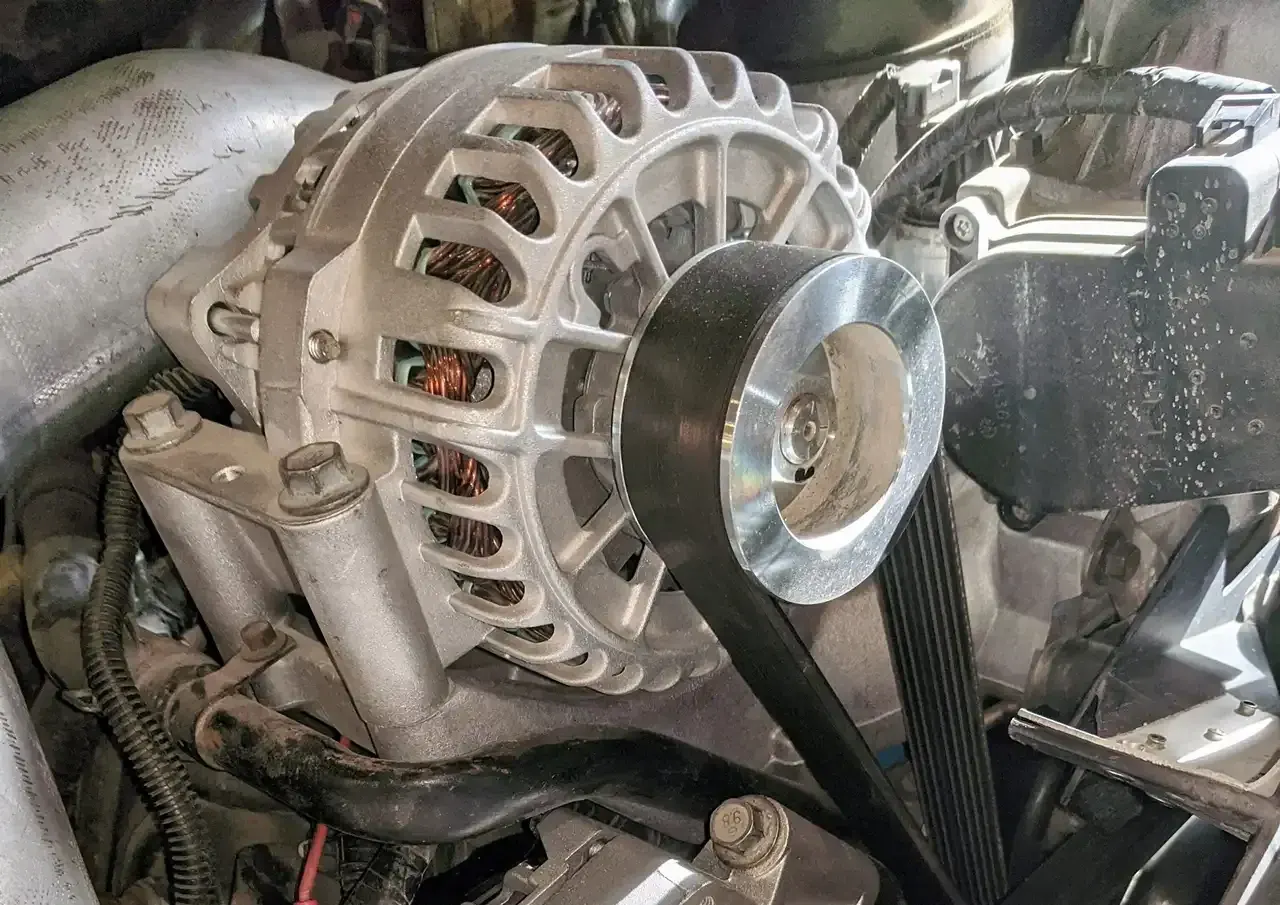
The alternator: a belt-driven generator
- Driven by a serpentine belt turning an internal rotor to generate three-phase AC, rectified to DC.
- Carries the full charging demand once the engine is above idle.
- Works alongside the battery, so either component can carry electrical load on its own.
That last point is the whole diagnostic problem: a failing alternator can present as a weak battery, and a weak battery as a failing alternator, until something is actually measured.
3. Failure modes and what they look like
- A slow morning crank with normal daytime restarts usually means sulfation or parasitic draw — a battery problem.
- Headlamps that brighten when you press the throttle mean insufficient alternator output at idle; belt glazing or brush wear are the usual causes.
- A reading above 15.5 V with a warm battery means regulator failure inside the alternator housing, and risks boiling the electrolyte.
- A sudden electrical shutdown at highway speed while static voltage looks fine in the yard means an alternator that failed under load; the battery masked it until it was flat.
- A high-frequency whine in the radio or CB points at diode ripple, which is the alternator rectifier pack.
- Starter problems that persist after a confirmed alternator replacement are internal battery resistance or corroded ground straps.
Each symptom should send the service writer to a test, not to a parts counter.
4. Step-by-step diagnostic workflow
- Visual inspection. Check belt tension — 12 mm maximum deflection — inspect for overheated cable lugs, and verify every ground bond.
- Static voltage check. A fully charged AGM battery reads 12.6 V after an hour at rest. Below 12.4 V means partial discharge or plate sulfation.
- Crank voltage observation. Log the lowest voltage during a cold start with a data-logging meter. A drop below 9.0 V at 21°C is borderline cold-cranking capacity.
- Open-circuit alternator test. Hold the engine at 1,500 rpm and measure system voltage. Below 13.8 V is under-charging; above 14.7 V at ambient is regulator overshoot.
- Dynamic load test. Switch on every load — defroster, trailer lamps, PTO pump. A healthy alternator holds 13.5 V or better.
- Voltage drop test. Measure losses on the positive and negative paths on a millivolt scale. Anything above 0.3 V is resistance that needs correction.
- Parasitic-draw analysis. After shutdown and module sleep — call it 30 minutes — clamp the negative cable. Above 50 mA, pull fuses to isolate the circuit.
Run in that order, this is troubleshooting rather than guesswork, and it is what keeps a truck from coming back for the same fault.
5. Battery lifecycle management
Heavy-duty batteries rarely fail abruptly. They decline measurably, which means the decline can be tracked.
- Conductance profiling. Quarterly testing avoids the false positives that temperature alone produces.
- Equalization charging. For flooded cells in standby fleets, equalization prevents stratification.
- Chemistry consistency. Never mix flooded and AGM chemistries in one parallel bank; the differing internal resistances sulfate the weaker type.
- Maintenance logs. Record every voltage drop test, CCA reading and replacement date in the fleet’s maintenance system. Those records are what support a warranty claim and a predictive replacement schedule.
6. Alternator service intervals and predictive indicators
Alternators fail from bearing fatigue, brush wear, diode failure or slip-ring erosion. Worth watching:
- Infrared thermal profiling. Compare case temperature to ambient; a delta above 40°C under light electrical load suggests a bearing on its way out.
- Oscilloscope ripple analysis. AC ripple above 500 mV under load means failing diodes, long before a dashboard lamp says so.
- Pulley alignment audits. Misalignment beyond 1 mm glazes belts and wears the tensioner early.
Strategic replacement at 450,000 km or 7,500 engine hours, whichever comes first, fits the same preventive logic as the rest of the program.
7. Seasonal considerations for Charlotte fleets
- Summer. Road grime and calcium chloride block alternator cooling; clean the case during mid-season PM.
- Winter. Battery capacity falls roughly one percent for every degree Celsius below 27°C. Pre-winter load testing and block heaters cut cold-start complaints.
- Hurricane season. Moisture accelerates terminal corrosion; apply dielectric grease after each PM-B interval.
8. Regulatory and warranty implications
49 CFR §393 requires that electrical circuits carry their loads without overheating. A misdiagnosed alternator that scorches harness insulation does more than strand a driver — it invites citations and an Out-of-Service order. Most OEM engine warranties also treat improper jump-starting or a battery mismatch as grounds for denial, so the documentation protects the operator as much as the truck.
Summary
Electrical faults on heavy-duty vehicles are not fixed by swapping parts. A systematic approach — visual checks, precise measurement, lifecycle records — determines whether the fault is the alternator or the battery, and does it once.
- Electrical
- Batteries
- Diagnostics